AFL Gather Round: The Importance of Finding YOUR Trybe

Jamie O'Keeffe • April 11, 2024

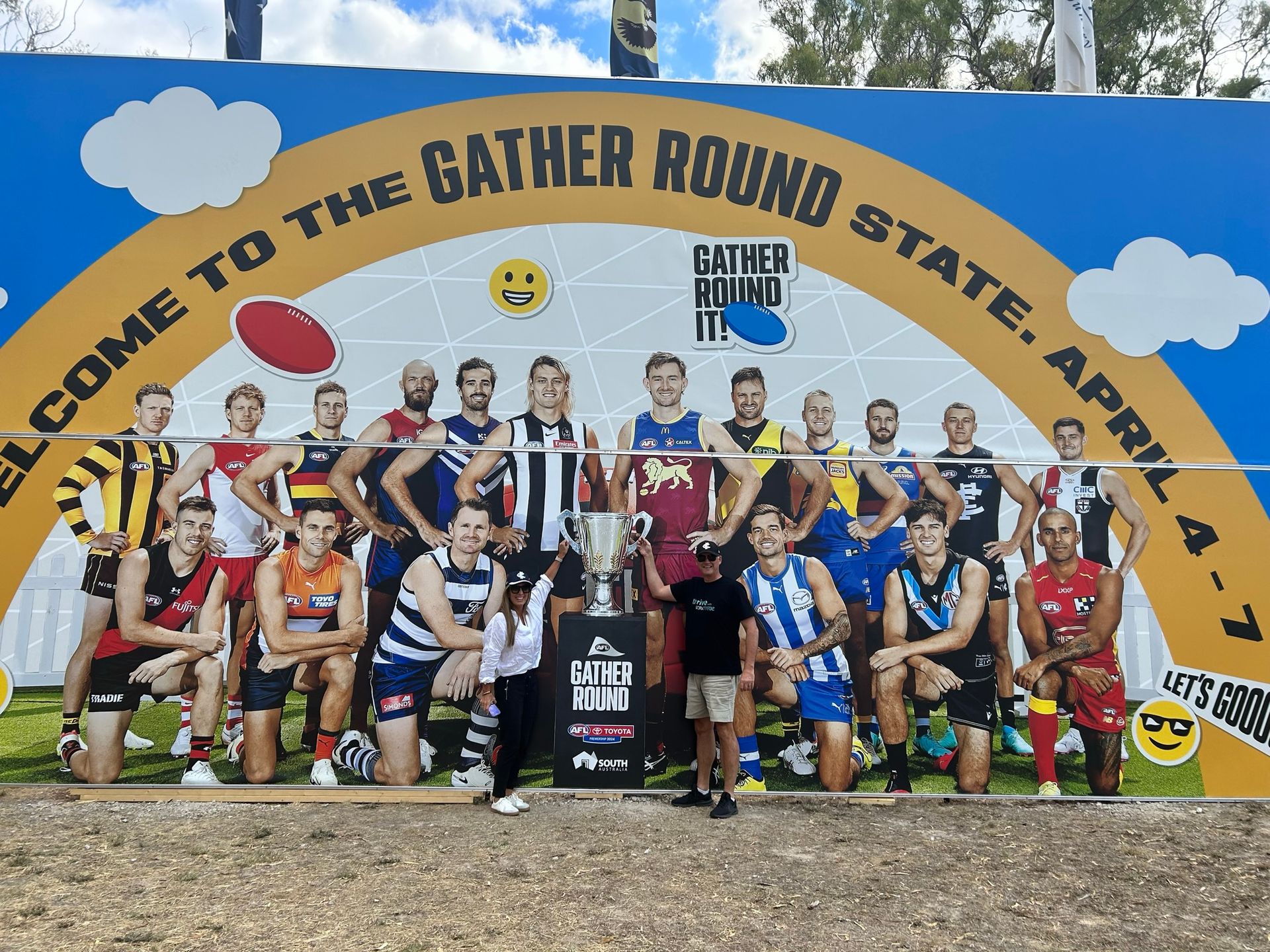
After personally experiencing the amazing weekend that is Gather Round in Adelaide last weekend, I had time to reflect (driving 8 hours home gives you plenty of time to reflect) on the phenomenon that is football and its impact on the Australian landscape.


As we all know, there are 5 seasons in a year; Autumn, Winter, Spring, Summer and 'Footy Season'. Being a passionate football follower since I was 6, I have always said the best day of the year is AFL Grand Final Day (Christmas Day for grownups!) and the worst day of the year is the day after as it's the furthest away from the start of the season. And every week during 'Footy Season' the passionate followers know it's not just about the game of football; it's about the tribes (we call them 'Trybes') that form around each team, creating a rich tapestry of identity, loyalty, and passion. As fans gather round to support their beloved teams, they become part of something larger than themselves—a community bonded by a common cause. Tribalism in AFL runs deep, ingrained in the fabric of Australian culture. From the bustling streets of Melbourne to the remote corners of Western Australia, supporters proudly don their team colours, chant their anthems, and celebrate victories with unwavering energy. But what exactly drives this sense of tribal loyalty?

At its core, supporting an AFL team is about belonging.


Humans are social creatures, drawn to groups that share common interests and values. For many, their football team becomes an extension of their identity—an emblem of who they are and where they come from. Whether it's the Magpies, Tigers, Eagles, Bombers or Blues, allegiance to a team often transcends mere fandom; it becomes a marker of one's place in the Australian landscape. After moving over to Melbourne from Perth 11 years ago, I was always fascinated with the 2 common questions that were asked early into any new meeting; the questions being 'Which school did you go to?' and 'Who do you follow in the football?' with a large number of people thinking that if I was from Perth I would have to either go for Eagles or Dockers, like there was no other option. But when you lift the lid on which team people follow you get to see a number of ways their allegiance has been created far beyond mere geographical allegiance. It's about family traditions passed down through generations, childhood memories forged at the MCG, and the camaraderie shared with fellow supporters. From the die-hard members who never miss a game to the casual fans who tune in for the Grand Final, each individual contributes to the collective spirit of their team's tribe.


In the digital age, social media has amplified the tribal nature of AFL support. Online forums, Facebook            groups, and Twitter threads serve as virtual meeting grounds where fans can connect, debate, and                commiserate with like-minded individuals. In this digital landscape, the boundaries of tribalism blur, allowing supporters from around the world to unite under a common banner. But with tribalism comes rivalry, and AFL is no stranger to heated competition both on and off the field. Matches between traditional rivals like the Carlton and Collingwood are more than just games; they're epic showdowns that pit tribe against tribe in a battle for supremacy. The banter, the taunts, and the sheer intensity of these clashes are a testament to the power of tribal identity in sport. Yet, for all its divisiveness, AFL tribalism also fosters a sense of community and belonging. Whether you're cheering alongside fellow supporters at the pub or high-fiving strangers in the stands, there's a shared sense of camaraderie that transcends differences. In a world increasingly fragmented by politics, religion, and ideology, the unifying power of sport offers a glimmer of hope for unity.

As another week of AFL action unfolds, fans across the country will gather round to support their teams, united in their love of the game and the tribes that bind them together. Whether it's the roar of the crowd, the thrill of victory, or the agony of defeat, one thing is certain: AFL tribalism is alive and well, shaping the landscape of Australian football for generations to come.


And just like in sport, finding a Trybe that shares your purpose and values is extremely important for human connection. Want that sense of belonging? Want to work for a company that shares your values and purpose! WorkTrybe can help!


Go Blues!!


A man in a blue suit and white shirt with his arms crossed

JAMIE O'KEEFFE, WORKTRYBE RECRUITMENT MARKETING MANAGER


Jamie O’Keeffe is WorkTrybe’s Recruitment Marketing Manager who has over 25 years experience in the media world having worked with highly recognised local, national and international media brands. 

WorkTrybe’s Recruitment Marketing division specialise in content creation, video production, editing, social media marketing.


Speak to Jamie today at Jamie.o’keeffe@worktrybe.com to arrange a coffee intro and find out how WorkTrybe can partner with you to make your Careers Page come ‘alive’.

By Kylie Saunders June 6, 2026
From 1 July, Payday Super becomes an operational stress test for growing SMEs For many growing businesses, Payday Super looks like a payroll compliance change. In reality, it’s much bigger than that. From 1 July, superannuation will need to be paid at the same time as wages rather than quarterly - and while the legislative change itself is straightforward, the operational impact for growing SMEs is likely to be far more significant. Because Payday Super doesn’t just change when super is paid. It increases the pressure on: Payroll accuracy Workforce data Onboarding processes System integration Cashflow timing Operational accountability And for businesses scaling beyond 30 employees, it will quickly expose whether current people systems are genuinely built to scale - or whether they’ve simply evolved over time. What actually changes - and why it matters Historically, many businesses have managed superannuation quarterly. That gap created breathing room. From 1 July, that buffer disappears. Super will need to move in line with payroll cycles, meaning errors, delays, or inconsistencies become visible much faster. On its own, that’s manageable. But where payroll, HR, onboarding, recruitment, and workforce data are operating separately - or relying on manual processes - even small inefficiencies can quickly create operational friction. And importantly, there’s also a cashflow shift. While Payday Super doesn’t increase the overall cost of superannuation, it changes the timing of how cash moves through the business. For growing SMEs already balancing recruitment, wage pressure, and operational growth, that adjustment may feel significant initially. This is why Payday Super is becoming less of a compliance conversation and more of an operational readiness conversation. Why growing businesses are particularly vulnerable In early-stage growth, most businesses build people processes organically. Spreadsheets fill gaps. Systems are added as needed. Payroll “works.” Recruitment happens reactively. Different functions operate independently. And for a while, that’s completely normal. But as headcount grows, complexity compounds. We often see businesses reach the 30-80 employee mark with: Payroll systems that aren’t connected to onboarding or HR workflows Multiple platforms with overlapping responsibilities Inconsistent employee data Underutilised or no “source of truth” for employee data or HR system Recruitment decisions increasing payroll complexity without supporting structure Unclear ownership across payroll, HR, finance, and hiring None of these issues are unusual. But Payday Super increases the cost of operational friction. What used to be manageable in quarterly cycles can become far more visible - and far more disruptive - when payroll and super obligations tighten into the same operating rhythm. The better question for growing businesses Rather than asking: “Are we compliant for Payday Super?” the more useful question is: “Are our workforce systems actually built to scale?” For most growing businesses, that comes down to a few fundamentals: Do we trust the accuracy of our workforce and payroll data? Do our systems communicate properly with one another? Is onboarding connected to payroll and HR workflows? Is there clear accountability across payroll, HR, hiring, and people operations? Can our current setup support another 20, 50, or 100 employees without increasing operational strain? These are often the questions already sitting beneath the surface and Payday Super simply brings them into focus much faster. What scalable businesses tend to do differently The businesses navigating this transition best are typically operating with a more connected workforce model. That doesn’t necessarily mean introducing more software. It usually means creating stronger alignment between: Payroll HR Recruitment Onboarding Workforce processes Leadership accountability At a practical level, scalable businesses tend to have: Connected workforce systems Embedded payroll and HR processes Clearer operational ownership Better visibility across workforce data Onboarding workflows that reduce downstream payroll risk Systems that are properly adopted, not just implemented Because when workforce operations scale well, compliance becomes significantly easier to manage. Where businesses often get stuck For many teams, the challenge isn’t recognising the issue. It’s knowing how to move forward while still running the business day-to-day. We commonly see businesses struggling with: Multiple vendors and no single point of accountability Systems implemented once but never fully embedded Reactive operational fixes instead of scalable processes Payroll, recruitment, and HR functions operating independently Growing workforce complexity without operational visibility Over time, this creates friction that becomes increasingly difficult to unwind. A more connected approach to workforce operations At WorkTrybe, we believe growing businesses need more than isolated HR support or standalone system implementations. They need workforce systems, operational support, and people processes that grow with the business. That’s why we work as a human-first workforce partner for growing SMEs - bringing together Employment Hero implementation, HR advisory, recruitment, payroll support, and workforce capability into one connected model. The goal isn’t simply to implement software or solve one-off problems. It’s to help businesses create workforce operations that feel scalable, practical, and sustainable as they grow. Parting thoughts Payday Super may appear to be an administrative change. But for growing SMEs, it’s likely to become a very real operational stress test. A moment that reveals whether current systems, processes, and workforce operations are built for the next stage of growth - or still operating the way they did when the business was smaller. The good news is that businesses still have time to prepare. Over the coming weeks, we’re helping growing businesses review whether their payroll, onboarding, HR, and workforce systems are genuinely ready for Payday Super and the operational pressure that comes with it. If you’d like a practical workforce readiness review before 1 July, feel free to reach out .

By Michael Guazzarotto April 22, 2025
Australia’s employment landscape is undergoing a major transformation. A growing number of professionals are stepping away from the traditional 9-to-5 model in favour of short-term, project-based roles . These contingent workers - whether contractors, freelancers, consultants, or temporary staff - now represent over 35% of the national workforce. That figure continues to rise as flexibility and autonomy become top priorities for both individuals and employers.  For medium-sized enterprises, leveraging contingent talent can offer the agility to fill skills gaps, respond to shifting demands, and better manage costs. But it takes more than just hiring a contractor - you need a structured approach and the right tech infrastructure to do it effectively. In this guide, we’ll explore how to integrate contingent workers into your broader workforce strategy. We’ll look at why this shift is accelerating, and how our partnership with Rippling is helping organisations adapt to this modern employment model.
By Michael Guazzarotto April 1, 2025
Recruiting and retaining skilled employees, particularly in lower-wage roles, is becoming an increasingly difficult challenge for many businesses across Australia. As industries face declining productivity, disengaged teams, and high turnover rates, the pressure is mounting for leaders to rethink their strategies. According to a recent report from The CEO Institute (Feb 2025), these issues are not just impacting day-to-day operations — they’re shaping the very future of organisations. In an era where the war for talent is fiercer than ever, businesses must shift from reactive hiring practices to proactive, strategic workforce planning. The need for skilled candidates is critical, but it’s equally important to create a work environment that encourages retention and productivity. This is where WorkTrybe steps in.
More Posts