"I'm Sooooooooo Busy!" Understanding Burnout and Mastering Workload Management

Merisha Percival • June 26, 2024

Does anyone get the response "I'm soooo busy!" when asked how they are?


“So busy” is a common phrase known to many of us, and for too long. I recall my family member sharing me this statement each family event we attended. So, I turned around and said, “You say that every time I see you, so what are you going to do differently?”.


Many of us find ourselves overwhelmed with tasks, battling a constant influx of emails, calls, instant messages, and meetings. Sometimes this environment in temporary bursts is positive, often leading to high productivity and engagement. However, a relentless pace can lead to burnout; a state of emotional, physical, and mental exhaustion caused by excessive and prolonged stress. To combat this, mastering workload management is crucial.

Understanding Burnout and Workload Management

Burnout manifests as chronic fatigue, cynicism, and a sense of ineffectiveness. It's not just about being tired; it's a serious condition that can impact both personal well-being and professional performance. Workload management, on the other hand, involves organising, prioritising, and completing tasks efficiently to maintain productivity and reduce stress. Effective workload management helps prevent burnout by ensuring that work demands do not exceed personal capacity. It’s a fine balance!


The Art of Distraction: Instant Messaging Overload

I love today’s communication tools like emails and instant messaging platforms (e.g., Microsoft Teams, Slack) are double-edged swords. Gone are the days of picking up the desk phone, waiting for those 10 dial tones; and then leaving a message to perhaps hear back in a couple of hours (if you’re lucky!).


While these modern platforms facilitate instant communication, they also create a constant source of interruptions. These distractions can fragment our focus and lead to increased stress and decreased productivity. Whilst most practices are innate in our day to day work, take the time to refresh or try a new approach to managing distractions by setting some boundaries and creating structured time for focused work.


Practical Tips to Stay Ahead and Reduce Workload Pressures

1) Prioritise Tasks with the Eisenhower Matrix: The Eisenhower Matrix is a time management tool that helps prioritize tasks based on urgency and importance. Categorize tasks into four quadrants:


  • Urgent and Important: Do these tasks immediately.
  • Important but Not Urgent: Schedule these tasks for later.
  • Urgent but Not Important: Delegate these tasks if possible.
  • Not Urgent and Not Important: Eliminate these tasks.


For example, an urgent client request (urgent and important) should be tackled first, while planning for a future project (important but not urgent) can be scheduled for later.


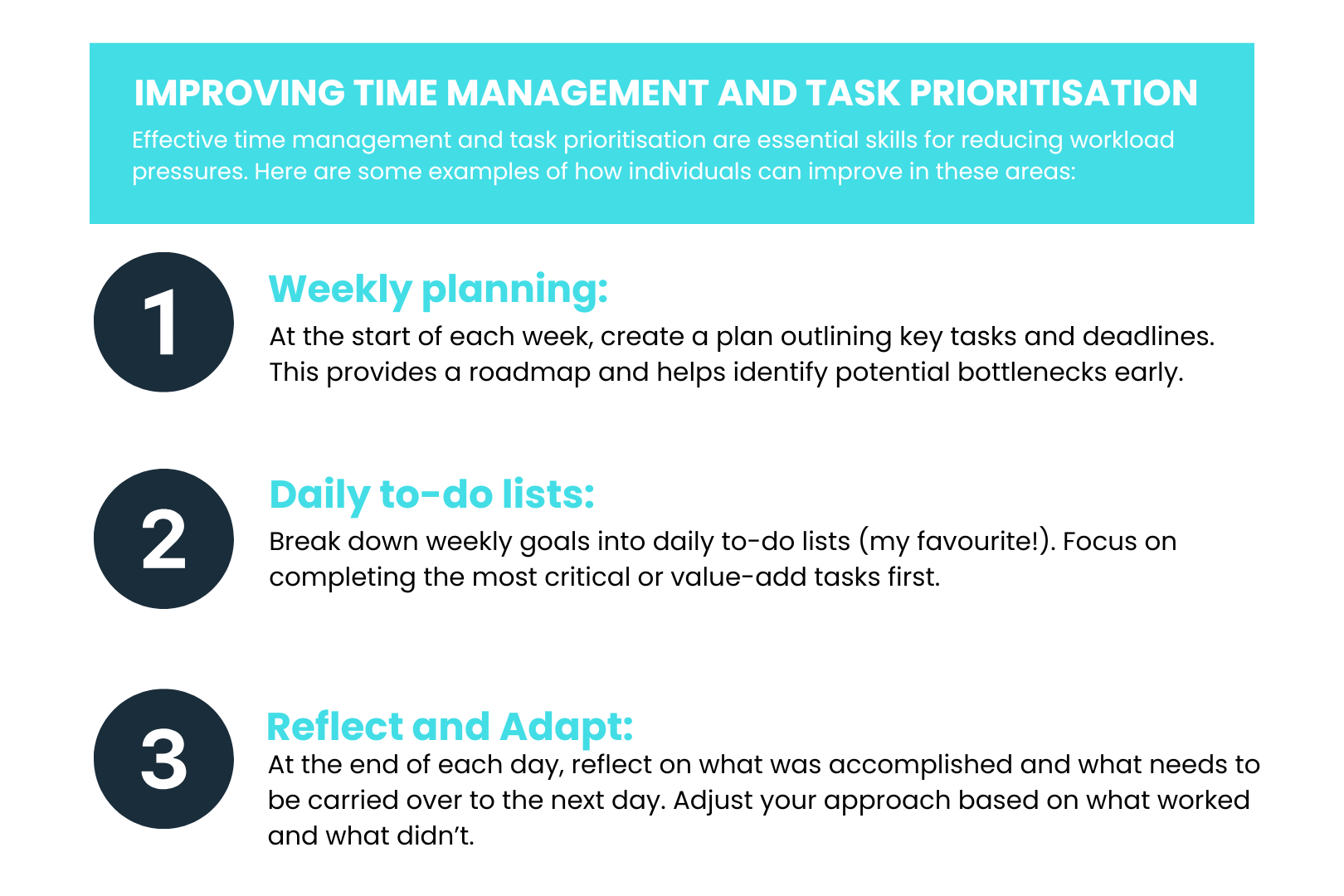
2) Time Blocking: Allocate specific blocks of time for focused work, meetings, and breaks. This method helps ensure that critical tasks receive dedicated attention without being disrupted by less important activities. For instance, designate an hour in the morning for deep work and another hour in the afternoon for responding to emails.


3) Ever considered using MS teams/outlook or related platforms to control your disruptions? Limit Distractions by:

  • Disable Notifications: Turn off non-essential notifications; or change the settings on your devices to minimise interruptions.
  • Set Communication Boundaries: Inform your team of your focused work periods and suggest alternative times for non-urgent communications.


4) Use the Pomodoro Technique: As an Italian I would agree that there is merit in daily siestas! This technique involves working for a set period (typically 25 minutes) followed by a short break. After four cycles, take a longer break. This approach helps maintain focus and reduces mental fatigue. For example, work on a report for 25 minutes, take a 5-minute break, and repeat.


5) Delegate and Collaborate: Ask the question, do I need to do this or can it be done by someone else? Don’t hesitate to delegate tasks to team members who have the capacity and interest to handle them. Collaboration tools can also help streamline team efforts and ensure that responsibilities are appropriately distributed.


6) Regularly Review and Adjust: Keep trying new ways and approaches. There isn’t a one size fit all model. Periodically assess your workload and adjust priorities, as necessary. This ensures that you remain aligned with your goals and can adapt to changing circumstances.

There are three key aspects in advancing gender targets.

For example, if you find that responding to emails is taking up too much of your time, allocate specific times during the day for email management, rather than constantly checking your inbox.


Conclusion

My family member was a little startled by my response to the common phrase “im soooooo busy”. These statements are usually dismissed or accepted as “part of your job”. When you hear this statement made by others or you hear yourself say this; don’t condone it; call it out. 


This is the calling card to address potential burnout and workload pressures. By prioritising tasks, setting boundaries on communications, and regularly reviewing your workload, you can mitigate the risk of burnout and maintain a healthier, more productive work-life balance. 


Remember, being busy is not the same as being productive—focus on what truly matters and manage your time wisely.


A woman in a grey jacket is smiling with her arms crossed

MERISHA PERCIVAL, WORKTRYBE DIRECTOR


Merisha is a consultative HR leader, having the pleasure of working in Engineering, Law, Pharmaceutical and Technology firms and agencies in Public, Private and Not-for-profit sectors. Merisha is described by others as an authentic, collaborative leader and coach, who inspires confidence, trust and respect in others. She enjoys partnering with Executives to align business objectives with HR strategy and prioritises the performance, engagement and welfare of people whilst maintaining mutual outcomes for an organisation. Merisha is commercially astute and understands the intrinsic benefits and nuances of business and HR capability, as such she maintains a balanced perspective when tackling complex people issues.


Speak to Merisha at merisha.percival@worktrybe.com to discuss how you can drive Diversity, Equity & Inclusion within your workplace.

By Kylie Saunders June 6, 2026
From 1 July, Payday Super becomes an operational stress test for growing SMEs For many growing businesses, Payday Super looks like a payroll compliance change. In reality, it’s much bigger than that. From 1 July, superannuation will need to be paid at the same time as wages rather than quarterly - and while the legislative change itself is straightforward, the operational impact for growing SMEs is likely to be far more significant. Because Payday Super doesn’t just change when super is paid. It increases the pressure on: Payroll accuracy Workforce data Onboarding processes System integration Cashflow timing Operational accountability And for businesses scaling beyond 30 employees, it will quickly expose whether current people systems are genuinely built to scale - or whether they’ve simply evolved over time. What actually changes - and why it matters Historically, many businesses have managed superannuation quarterly. That gap created breathing room. From 1 July, that buffer disappears. Super will need to move in line with payroll cycles, meaning errors, delays, or inconsistencies become visible much faster. On its own, that’s manageable. But where payroll, HR, onboarding, recruitment, and workforce data are operating separately - or relying on manual processes - even small inefficiencies can quickly create operational friction. And importantly, there’s also a cashflow shift. While Payday Super doesn’t increase the overall cost of superannuation, it changes the timing of how cash moves through the business. For growing SMEs already balancing recruitment, wage pressure, and operational growth, that adjustment may feel significant initially. This is why Payday Super is becoming less of a compliance conversation and more of an operational readiness conversation. Why growing businesses are particularly vulnerable In early-stage growth, most businesses build people processes organically. Spreadsheets fill gaps. Systems are added as needed. Payroll “works.” Recruitment happens reactively. Different functions operate independently. And for a while, that’s completely normal. But as headcount grows, complexity compounds. We often see businesses reach the 30-80 employee mark with: Payroll systems that aren’t connected to onboarding or HR workflows Multiple platforms with overlapping responsibilities Inconsistent employee data Underutilised or no “source of truth” for employee data or HR system Recruitment decisions increasing payroll complexity without supporting structure Unclear ownership across payroll, HR, finance, and hiring None of these issues are unusual. But Payday Super increases the cost of operational friction. What used to be manageable in quarterly cycles can become far more visible - and far more disruptive - when payroll and super obligations tighten into the same operating rhythm. The better question for growing businesses Rather than asking: “Are we compliant for Payday Super?” the more useful question is: “Are our workforce systems actually built to scale?” For most growing businesses, that comes down to a few fundamentals: Do we trust the accuracy of our workforce and payroll data? Do our systems communicate properly with one another? Is onboarding connected to payroll and HR workflows? Is there clear accountability across payroll, HR, hiring, and people operations? Can our current setup support another 20, 50, or 100 employees without increasing operational strain? These are often the questions already sitting beneath the surface and Payday Super simply brings them into focus much faster. What scalable businesses tend to do differently The businesses navigating this transition best are typically operating with a more connected workforce model. That doesn’t necessarily mean introducing more software. It usually means creating stronger alignment between: Payroll HR Recruitment Onboarding Workforce processes Leadership accountability At a practical level, scalable businesses tend to have: Connected workforce systems Embedded payroll and HR processes Clearer operational ownership Better visibility across workforce data Onboarding workflows that reduce downstream payroll risk Systems that are properly adopted, not just implemented Because when workforce operations scale well, compliance becomes significantly easier to manage. Where businesses often get stuck For many teams, the challenge isn’t recognising the issue. It’s knowing how to move forward while still running the business day-to-day. We commonly see businesses struggling with: Multiple vendors and no single point of accountability Systems implemented once but never fully embedded Reactive operational fixes instead of scalable processes Payroll, recruitment, and HR functions operating independently Growing workforce complexity without operational visibility Over time, this creates friction that becomes increasingly difficult to unwind. A more connected approach to workforce operations At WorkTrybe, we believe growing businesses need more than isolated HR support or standalone system implementations. They need workforce systems, operational support, and people processes that grow with the business. That’s why we work as a human-first workforce partner for growing SMEs - bringing together Employment Hero implementation, HR advisory, recruitment, payroll support, and workforce capability into one connected model. The goal isn’t simply to implement software or solve one-off problems. It’s to help businesses create workforce operations that feel scalable, practical, and sustainable as they grow. Parting thoughts Payday Super may appear to be an administrative change. But for growing SMEs, it’s likely to become a very real operational stress test. A moment that reveals whether current systems, processes, and workforce operations are built for the next stage of growth - or still operating the way they did when the business was smaller. The good news is that businesses still have time to prepare. Over the coming weeks, we’re helping growing businesses review whether their payroll, onboarding, HR, and workforce systems are genuinely ready for Payday Super and the operational pressure that comes with it. If you’d like a practical workforce readiness review before 1 July, feel free to reach out .

By Michael Guazzarotto April 22, 2025
Australia’s employment landscape is undergoing a major transformation. A growing number of professionals are stepping away from the traditional 9-to-5 model in favour of short-term, project-based roles . These contingent workers - whether contractors, freelancers, consultants, or temporary staff - now represent over 35% of the national workforce. That figure continues to rise as flexibility and autonomy become top priorities for both individuals and employers.  For medium-sized enterprises, leveraging contingent talent can offer the agility to fill skills gaps, respond to shifting demands, and better manage costs. But it takes more than just hiring a contractor - you need a structured approach and the right tech infrastructure to do it effectively. In this guide, we’ll explore how to integrate contingent workers into your broader workforce strategy. We’ll look at why this shift is accelerating, and how our partnership with Rippling is helping organisations adapt to this modern employment model.
By Michael Guazzarotto April 1, 2025
Recruiting and retaining skilled employees, particularly in lower-wage roles, is becoming an increasingly difficult challenge for many businesses across Australia. As industries face declining productivity, disengaged teams, and high turnover rates, the pressure is mounting for leaders to rethink their strategies. According to a recent report from The CEO Institute (Feb 2025), these issues are not just impacting day-to-day operations — they’re shaping the very future of organisations. In an era where the war for talent is fiercer than ever, businesses must shift from reactive hiring practices to proactive, strategic workforce planning. The need for skilled candidates is critical, but it’s equally important to create a work environment that encourages retention and productivity. This is where WorkTrybe steps in.
More Posts