How can your company's Careers Page increase your profitability?

Jamie O'Keeffe • November 14, 2023

Company Careers Pages. Most companies have one. Some see it as a matter of simply posting jobs available whilst others understand the true value of this page in terms of educating and engaging with potential candidates.


So how can your Careers Page increase your company’s profitability?


Simple, when done right your Careers Page can do the following:

·      Gain Higher quality candidates to apply (shifting your performance gauge)

·      Find the right candidates that fit your company culture

·      Minimise staff turnover

·      Fast track performance ramp for new employees


Today’s workforce want to know all about a company before they apply for a role. Areas such as a company’s work /home flexibility, diversity, equity & inclusion, rewards and recognition and overall employee value proposition need to be readily available to educate a company’s target audience.


"CONTENT IS KING"

Bill Gates (1996)

In today’s digital age, where attention spans are fleeting and information overload is the norm, companies must find innovative ways to engage with potential candidates. One such powerful tool that has gained significant traction in recent years is video content. Your brain processes visuals 60,000 times faster than text and so it is imperative to make your companies career page come ‘alive’ with visual content.


There are 7 reasons why video content is crucial for a company’s career page and how it can significantly impact on the recruitment process for the better.


1.    Humanize the Company

Video content provides a unique opportunity to showcase the human side of a company. Through video content, companies can introduce team members, highlight their diverse talents and present the company culture authentically. Potential employees get a glimpse into the day-to-day workings of the organisation, creating a sense of belonging and builds trust in the company even before they apply.


2.    Engaging and Memorable

Visual and auditory elements make video a highly engaging medium. A well created video can convey a company’s mission, vision & values as well as their employee value proposition more effectively. Videos are more likely to be remembered compared to standard text which enables your company to stand out in the minds of potential candidates.


3.    Showcasing Company Culture

Company culture plays a pivotal role in attracting the right talent. Videos can provide an insider’s view of the workplace, allowing prospective employees to gain a clear understanding of the work atmosphere, team dynamics and core values. This transparency

helps candidates to assess if they align to your company’s culture even before they apply which in turn leads to more suitable long-term hires.


4.    Demonstrating Opportunities for Career Growth

Video content on your Careers Page also enables your company to showcase the varying career paths and growth opportunities within your organisation. Staff testimonial videos discussing their career path/journey highlight the company’s focus and commitment to employee development and advancement.


5.    Enhance Your Company Branding

Your company essentially has two brand messages, one you promote to your clients (both current and potential) and the second is your brand message to current and future employees. Building a strong employer brand is a magnet for top talent and naturally you want the best to want to work for you. Compelling videos can highlight awards, achievements, social responsibilities and commitments highlighting that your company is not just a workplace but a community that contributes positively to society.


6.    Improve SEO and Online Visibility

Search engines prioritize video content, and websites with videos are more likely to rank higher in search results. By incorporating videos on the career page, companies can enhance their online visibility. This increased visibility can attract more high-quality candidates, ensuring a diverse pool of applicants for every job opening.


7.    Speak to Modern Job Seekers

If you are actively speaking to Millennials and Generation Z, there preference of consuming information is through videos. A company that invests in video content demonstrates its willingness to adapt to modern communication preferences, making it more appealing to modern job seekers.


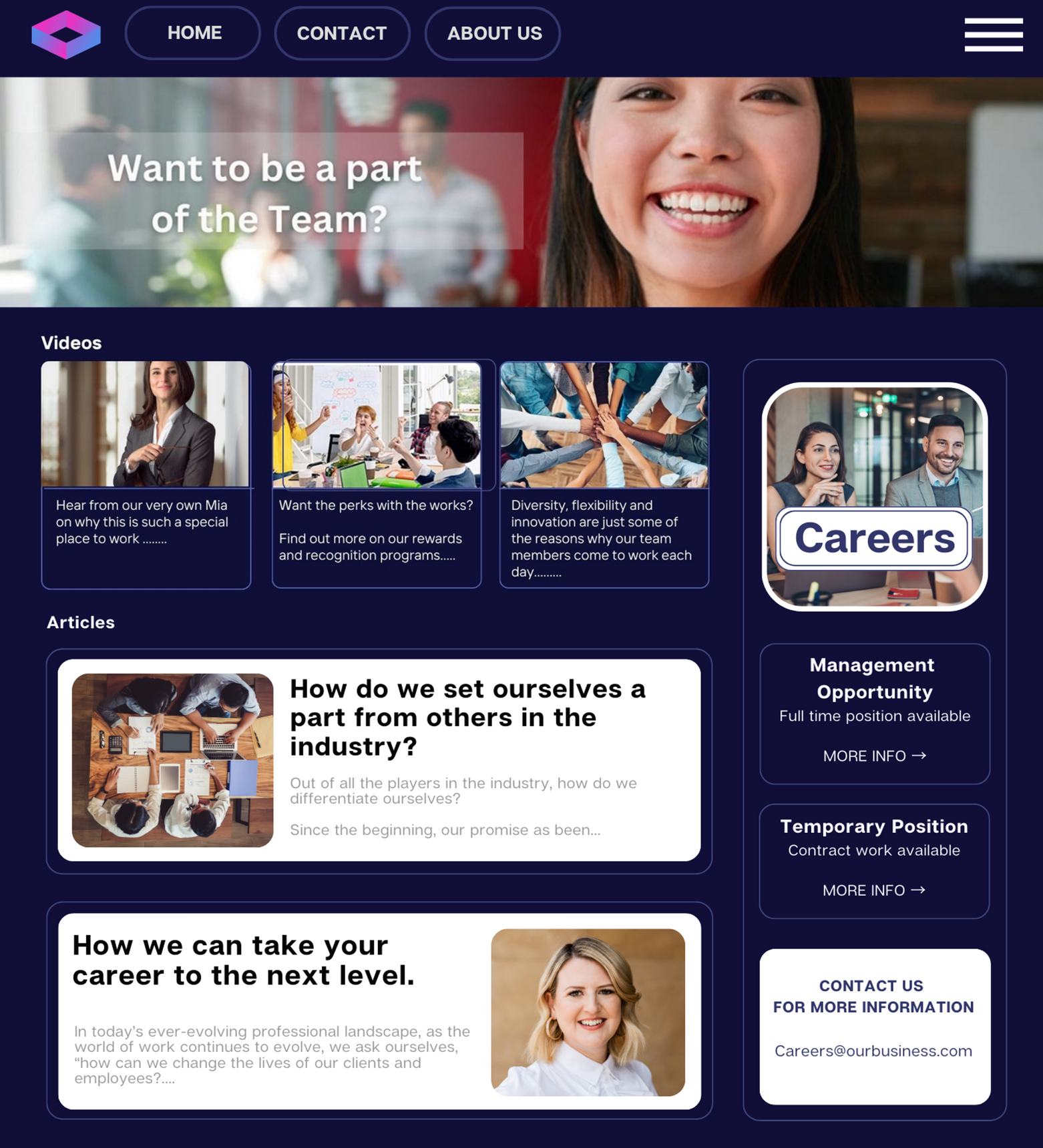
A screenshot of a website that says `` want to be a part of the team ? ''

Making your company’s career page with video content is not merely a ‘nice thing to have’, It’s a strategic investment in transforming the recruitment process. By humanizing the company, engaging with potential candidates (possibly even before roles are available), educating the target audience about your company’s culture, workforce flexibility and overall employee value proposition will increase your companies profit by giving you higher quality candidates, minimise churn and fast track the recruitment process.


A man in a blue suit and white shirt with his arms crossed

JAMIE O'KEEFFE, WORKTRYBE RECRUITMENT MARKETING MANAGER


Jamie O’Keeffe is WorkTrybe’s Recruitment Marketing Manager who has over 25 years experience in the media world having worked with highly recognised local, national and international media brands. 

WorkTrybe’s Recruitment Marketing division specialise in content creation, video production, editing, social media marketing.


Speak to Jamie today at Jamie.o’keeffe@worktrybe.com to arrange a coffee intro and find out how WorkTrybe can partner with you to make your Careers Page come ‘alive’.

By Kylie Saunders June 6, 2026
From 1 July, Payday Super becomes an operational stress test for growing SMEs For many growing businesses, Payday Super looks like a payroll compliance change. In reality, it’s much bigger than that. From 1 July, superannuation will need to be paid at the same time as wages rather than quarterly - and while the legislative change itself is straightforward, the operational impact for growing SMEs is likely to be far more significant. Because Payday Super doesn’t just change when super is paid. It increases the pressure on: Payroll accuracy Workforce data Onboarding processes System integration Cashflow timing Operational accountability And for businesses scaling beyond 30 employees, it will quickly expose whether current people systems are genuinely built to scale - or whether they’ve simply evolved over time. What actually changes - and why it matters Historically, many businesses have managed superannuation quarterly. That gap created breathing room. From 1 July, that buffer disappears. Super will need to move in line with payroll cycles, meaning errors, delays, or inconsistencies become visible much faster. On its own, that’s manageable. But where payroll, HR, onboarding, recruitment, and workforce data are operating separately - or relying on manual processes - even small inefficiencies can quickly create operational friction. And importantly, there’s also a cashflow shift. While Payday Super doesn’t increase the overall cost of superannuation, it changes the timing of how cash moves through the business. For growing SMEs already balancing recruitment, wage pressure, and operational growth, that adjustment may feel significant initially. This is why Payday Super is becoming less of a compliance conversation and more of an operational readiness conversation. Why growing businesses are particularly vulnerable In early-stage growth, most businesses build people processes organically. Spreadsheets fill gaps. Systems are added as needed. Payroll “works.” Recruitment happens reactively. Different functions operate independently. And for a while, that’s completely normal. But as headcount grows, complexity compounds. We often see businesses reach the 30-80 employee mark with: Payroll systems that aren’t connected to onboarding or HR workflows Multiple platforms with overlapping responsibilities Inconsistent employee data Underutilised or no “source of truth” for employee data or HR system Recruitment decisions increasing payroll complexity without supporting structure Unclear ownership across payroll, HR, finance, and hiring None of these issues are unusual. But Payday Super increases the cost of operational friction. What used to be manageable in quarterly cycles can become far more visible - and far more disruptive - when payroll and super obligations tighten into the same operating rhythm. The better question for growing businesses Rather than asking: “Are we compliant for Payday Super?” the more useful question is: “Are our workforce systems actually built to scale?” For most growing businesses, that comes down to a few fundamentals: Do we trust the accuracy of our workforce and payroll data? Do our systems communicate properly with one another? Is onboarding connected to payroll and HR workflows? Is there clear accountability across payroll, HR, hiring, and people operations? Can our current setup support another 20, 50, or 100 employees without increasing operational strain? These are often the questions already sitting beneath the surface and Payday Super simply brings them into focus much faster. What scalable businesses tend to do differently The businesses navigating this transition best are typically operating with a more connected workforce model. That doesn’t necessarily mean introducing more software. It usually means creating stronger alignment between: Payroll HR Recruitment Onboarding Workforce processes Leadership accountability At a practical level, scalable businesses tend to have: Connected workforce systems Embedded payroll and HR processes Clearer operational ownership Better visibility across workforce data Onboarding workflows that reduce downstream payroll risk Systems that are properly adopted, not just implemented Because when workforce operations scale well, compliance becomes significantly easier to manage. Where businesses often get stuck For many teams, the challenge isn’t recognising the issue. It’s knowing how to move forward while still running the business day-to-day. We commonly see businesses struggling with: Multiple vendors and no single point of accountability Systems implemented once but never fully embedded Reactive operational fixes instead of scalable processes Payroll, recruitment, and HR functions operating independently Growing workforce complexity without operational visibility Over time, this creates friction that becomes increasingly difficult to unwind. A more connected approach to workforce operations At WorkTrybe, we believe growing businesses need more than isolated HR support or standalone system implementations. They need workforce systems, operational support, and people processes that grow with the business. That’s why we work as a human-first workforce partner for growing SMEs - bringing together Employment Hero implementation, HR advisory, recruitment, payroll support, and workforce capability into one connected model. The goal isn’t simply to implement software or solve one-off problems. It’s to help businesses create workforce operations that feel scalable, practical, and sustainable as they grow. Parting thoughts Payday Super may appear to be an administrative change. But for growing SMEs, it’s likely to become a very real operational stress test. A moment that reveals whether current systems, processes, and workforce operations are built for the next stage of growth - or still operating the way they did when the business was smaller. The good news is that businesses still have time to prepare. Over the coming weeks, we’re helping growing businesses review whether their payroll, onboarding, HR, and workforce systems are genuinely ready for Payday Super and the operational pressure that comes with it. If you’d like a practical workforce readiness review before 1 July, feel free to reach out .

By Michael Guazzarotto April 22, 2025
Australia’s employment landscape is undergoing a major transformation. A growing number of professionals are stepping away from the traditional 9-to-5 model in favour of short-term, project-based roles . These contingent workers - whether contractors, freelancers, consultants, or temporary staff - now represent over 35% of the national workforce. That figure continues to rise as flexibility and autonomy become top priorities for both individuals and employers.  For medium-sized enterprises, leveraging contingent talent can offer the agility to fill skills gaps, respond to shifting demands, and better manage costs. But it takes more than just hiring a contractor - you need a structured approach and the right tech infrastructure to do it effectively. In this guide, we’ll explore how to integrate contingent workers into your broader workforce strategy. We’ll look at why this shift is accelerating, and how our partnership with Rippling is helping organisations adapt to this modern employment model.
By Michael Guazzarotto April 1, 2025
Recruiting and retaining skilled employees, particularly in lower-wage roles, is becoming an increasingly difficult challenge for many businesses across Australia. As industries face declining productivity, disengaged teams, and high turnover rates, the pressure is mounting for leaders to rethink their strategies. According to a recent report from The CEO Institute (Feb 2025), these issues are not just impacting day-to-day operations — they’re shaping the very future of organisations. In an era where the war for talent is fiercer than ever, businesses must shift from reactive hiring practices to proactive, strategic workforce planning. The need for skilled candidates is critical, but it’s equally important to create a work environment that encourages retention and productivity. This is where WorkTrybe steps in.
More Posts